
How to Troll Spoons for Trout & Salmon
How to troll spoons for trout and salmon: speed ranges, real-metal finishes, hooks, leaders, and running spoons clean.
Trolling spoons are search baits: run them clean, fast, and cover water to find active fish. Cal Kellogg builds his spoon spread around three speeds. Fish a Junior Trigger Spoon slow at 1.5 to 2.2 mph, the Trigger Spoon medium at 2.4 to 3 mph, and a Speed Spoon fast up to 4 mph. Run real metal finishes on 8 to 12 lb fluorocarbon. Never run a trout spoon behind a dodger.
How do you troll spoons for trout?
Run the spoon clean on a fluorocarbon leader and cover water at 2.5 to 3.5 mph to find active fish. Cal Kellogg treats spoons as search baits that appeal to the 10 to 15 percent of trout willing to chase. Once you pop a fish or two, you have found the zone and can slow down or switch baits.
What speed should I troll spoons?
Match the spoon to the speed. A Junior Trigger Spoon works slow at 1.5 to 2.2 mph, the full-size Trigger Spoon runs medium at 2.4 to 3 mph, and the Speed Spoon burns fast from 2.6 up to 4 mph. Test each spoon boatside to learn the speed where it swims best.
Should I run a trout spoon behind a dodger?
No. Spoons are meant to run clean at trolling speed so their own wobble triggers the strike. Cal Kellogg reminds anglers you do not need dodgers and flashers to catch good fish on a spoon. Match the size of the local bait instead, like a slim Pinhead Spoon when trout key on thin pond smelt.
What spoon finish catches the most fish?
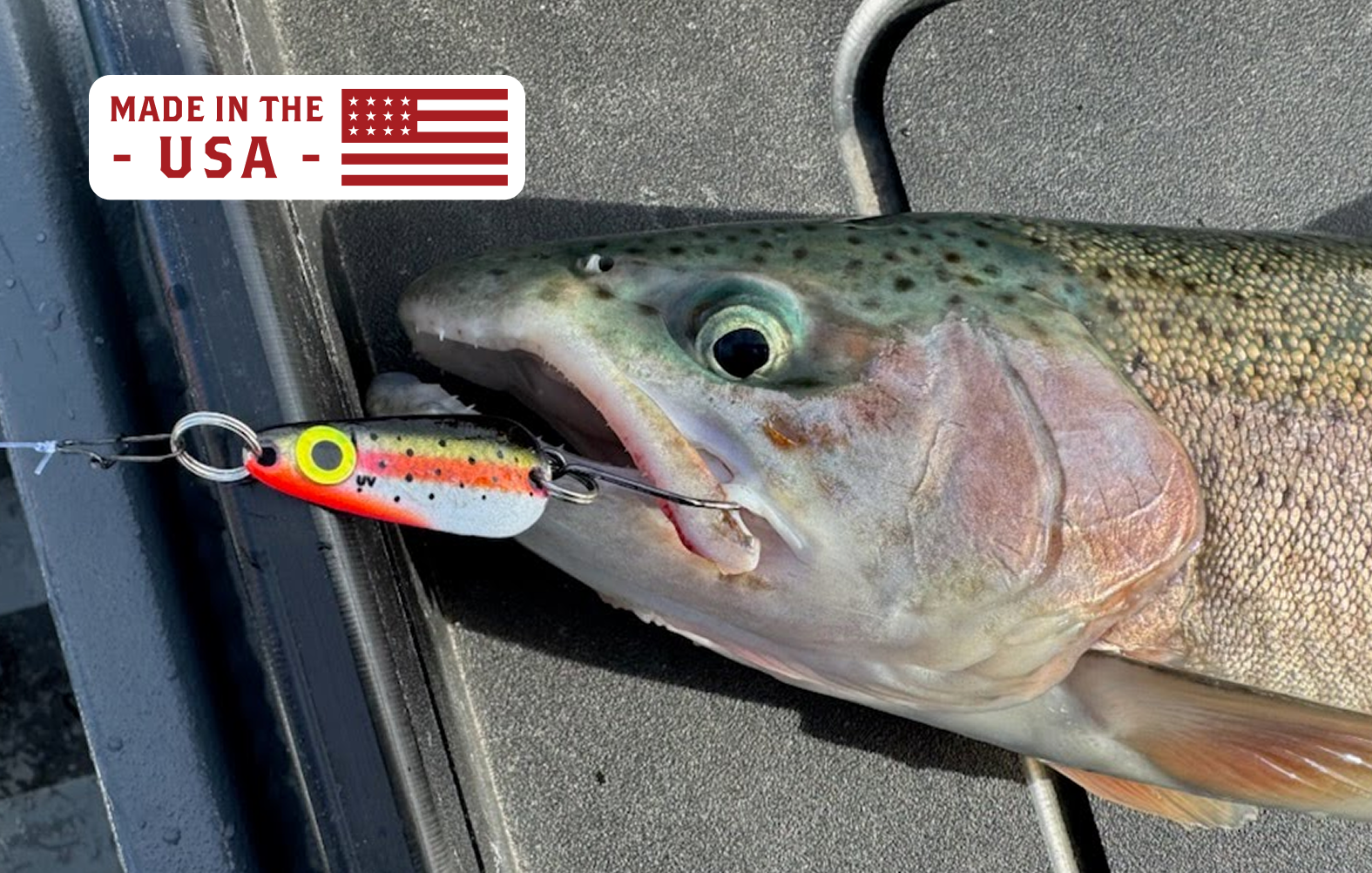
Real metal beats imitation. Cal Kellogg plates his spoons in genuine silver, 24 karat gold, and pure copper because they consistently outfish chrome and brass. A dark-over-light pattern and a prismatic eye complete the bait fish look. Always carry the plain silver, gold, and copper metallics as your core colors.
What hook should I run on a trout spoon?
Cal Kellogg arms his spoons with high-quality VMC J hooks and stainless split rings. A J hook lands more of the fish you hook than a treble does. A kokanee trick helps: grab the hook with pliers and give the point a slight twist so it sits offset from the shank, which improves your hookup rate.
What leader should I use for spoons?
Always run fluorocarbon, and do not go too light. Cal Kellogg uses 8 lb as a minimum, 10 lb as standard, and 12 lb when big fish are around. He has landed 9 and 10 pound fish on trolled spoons, so match your leader strength to the biggest fish the lake can give up.
How deep should I troll spoons?
Set the spoon just above the fish. Cal Kellogg has trolled a Trigger Spoon 55 to 90 feet down on a downrigger for landlocked kings, and run a small spoon 5 feet deep on one color of leadcore or 2 feet deep on a top line for shallow trout. Let your sonar set the depth.
Watch the technique
Trolling spoons for trout and salmon FAQ
Yes. In 45 degree Sierra water Cal Kellogg slows to 1.8 to 2 mph and runs an orange and chrome Junior Trigger Spoon on leadcore plus a Disco Minnow Junior on a top line. Bites are tentative in cold water, so keep the lure just under the surface where the most active fish hold.
Its narrow profile mimics thin pond smelt, which trout and salmon sometimes prefer. The Pinhead Spoon also fishes at almost any speed, from 1.4 up past 3 mph. Cal Kellogg has caught big Folsom kings on one after the fish coughed up small bait. A small spoon still catches large fish.
Fewer than you think, but you need a spread. Carry the core metallics in silver, gold, and copper, then add a few painted and UV patterns you have confidence in. Cal Kellogg has watched fish choose one clown pattern over a nearly identical one by five to one, so color and pattern matter.
You hook more fish on a treble but lose more of them too. Cal Kellogg switched to quality VMC J hooks because they hook and hold, so you land a higher percentage. Offset the J hook point slightly with pliers for even better hookups.
It means covering water fast, 2.5 mph and up, with spoons run clean to trigger aggressive fish. It is the opposite of slow trolling behind a dodger. Power trolling lets you find active fish quickly, then work that area harder once you connect.
Yes. Cal Kellogg adds reflective diamond tape in different colors to plain silver and gold spoons to dial in a pattern for the day. When the fish want a change, peel the tape, wipe the spoon with alcohol, and re-tape. Precision does not matter, contrast does.
- Trigger Spoon 2.25" - Trout & Landlocked Salmon
- Junior Trigger Spoon 1.25" - Trout & Salmon
- Speed Spoon 2.5" - Power Trolling Spoon
- Pinhead Spoon - Kokanee & Trout Trolling Spoon
- Disco Minnow Junior Spoon - Trout & Salmon
- Optimizer Size 3 3.625" - Trout & Salmon Trolling Spoon
- Fast Troll Spoon System